
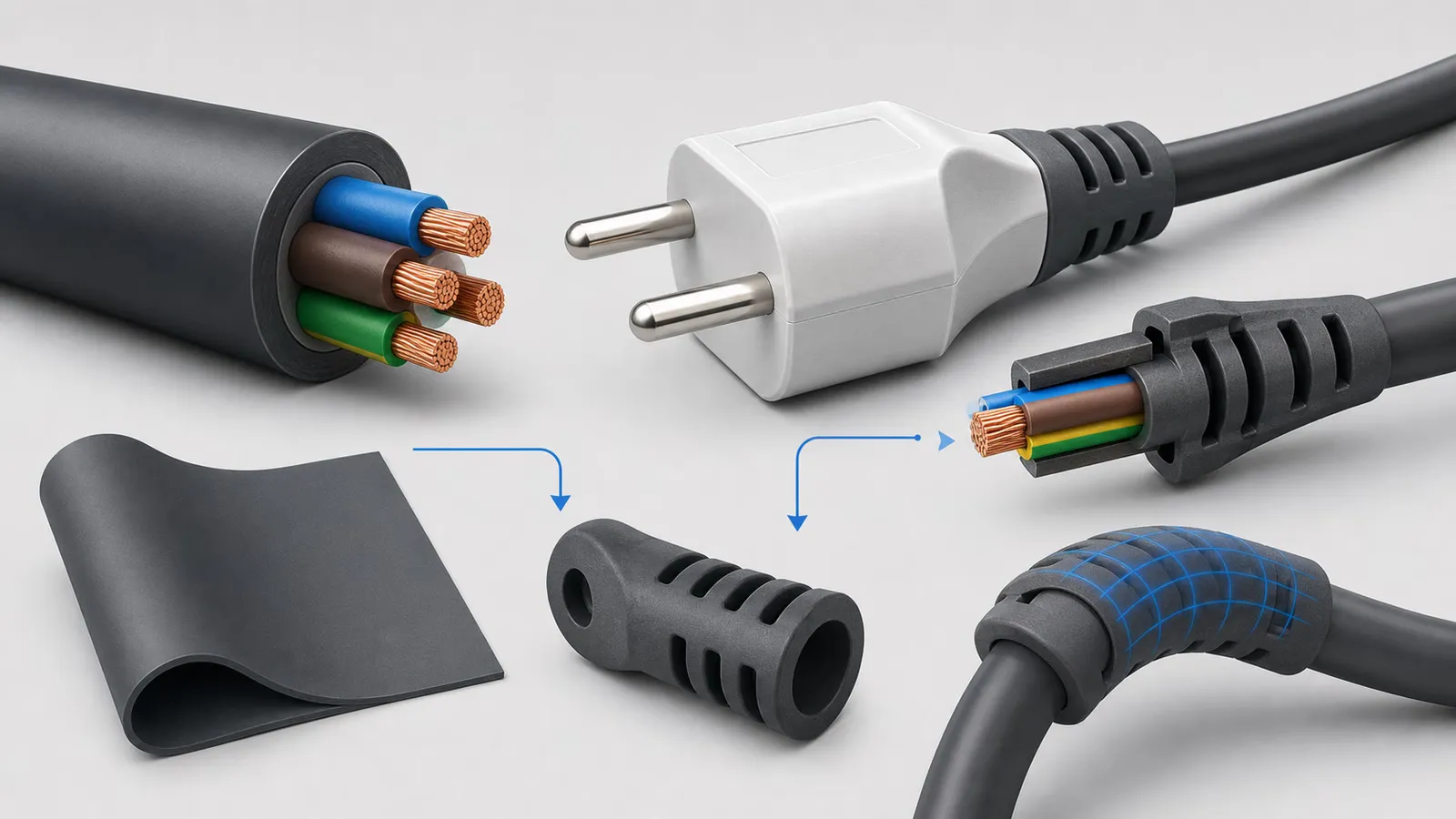
Soft PVC Cable Overmolding Defects: Material and Workflow Review
Review soft PVC cable overmolding defects by checking cable positioning, terminal support, material condition, mold shutoff, filling behavior, and machine access.
2026-07-12 - 6 min material note - Category: Soft & Flexible Materials
Soft PVC cable overmolding can show defects that look like material problems but actually come from cable positioning, fixture support, mold shutoff, or loading workflow. The material is only one part of the process.
For cable, plug, and connector products, repeatable placement before mold close is often the core production requirement.
What You May See
- Cable or terminal shifts during molding.
- Flash around cable exits or terminal areas.
- Short shot near wire paths or thin features.
- Surface marks, burn marks, or material degradation.
- Strain relief shape is inconsistent.
Review Points
Start by checking whether the defect follows a cable position, terminal, fixture, cavity, or operator loading step.
Review:
- Exact soft PVC grade and supplier notes.
- Cable diameter, terminal shape, and assembly tolerance.
- Fixture support and wire routing before mold close.
- Mold shutoff around cable exits.
- Gate position and flow path around terminals.
- Operator access, table layout, and loading repeatability.
Machine Configuration Notes
DC Series Tie-bar-less Vertical Clamping Machines may be discussed when cable or terminal placement benefits from open mold access. DC Series is defined by tie-bar-less vertical clamping; injection direction depends on configuration.
Slide table machines may help when the lower mold needs to move out for cable placement and part removal.
Related Reading
Related Reading
FAQ
Material review questions
Are soft PVC cable defects only material problems?
Need material-specific machine advice?
Send the exact material grade, product drawing, insert or substrate details, mold layout, and production target so Deboge can review the machine configuration discussion.