
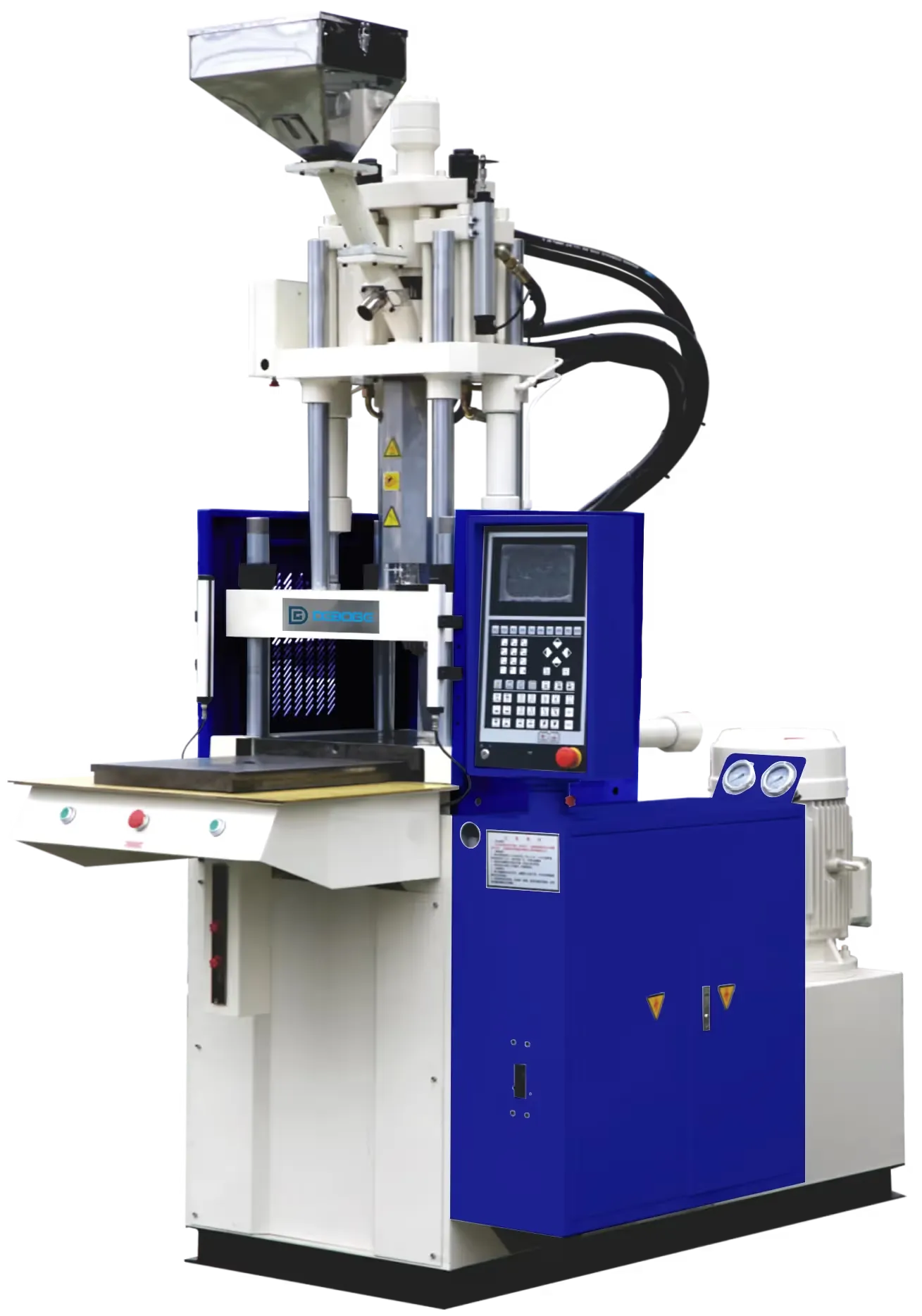
Slide Table Vertical Injection Molding Machines
Slide table machines bring the lower mold platen toward the operator, giving insert loading and part removal a dedicated position outside the clamping area.
Single and double slide layouts should be compared by loading time, output target, mold access, and how much operator handling the process requires.
Table Configuration
Move the mold to the operator - safer access, faster loading
In a slide table configuration, the lower platen travels on linear rails between two positions: a molding position under the clamping unit and a loading position in front of the operator. Instead of the operator reaching into the clamping area to place inserts and remove parts, the mold comes to the operator.
This separation of loading and clamping zones improves operator safety - hands stay clear of the mold closing area - and makes insert placement more ergonomic, especially for multi-cavity molds or complex insert geometries that require careful positioning.
- Operator stays clear of clamp Mold moves out for loading - hands never enter the clamping zone during operation
- Two capacity levels Single slide for batch work, double slide for alternating higher-output workflows
- Better ergonomics Open access to the mold at a comfortable working height and position
- Flexible insert handling Suitable for manual and semi-automated loading across a wide range of insert types
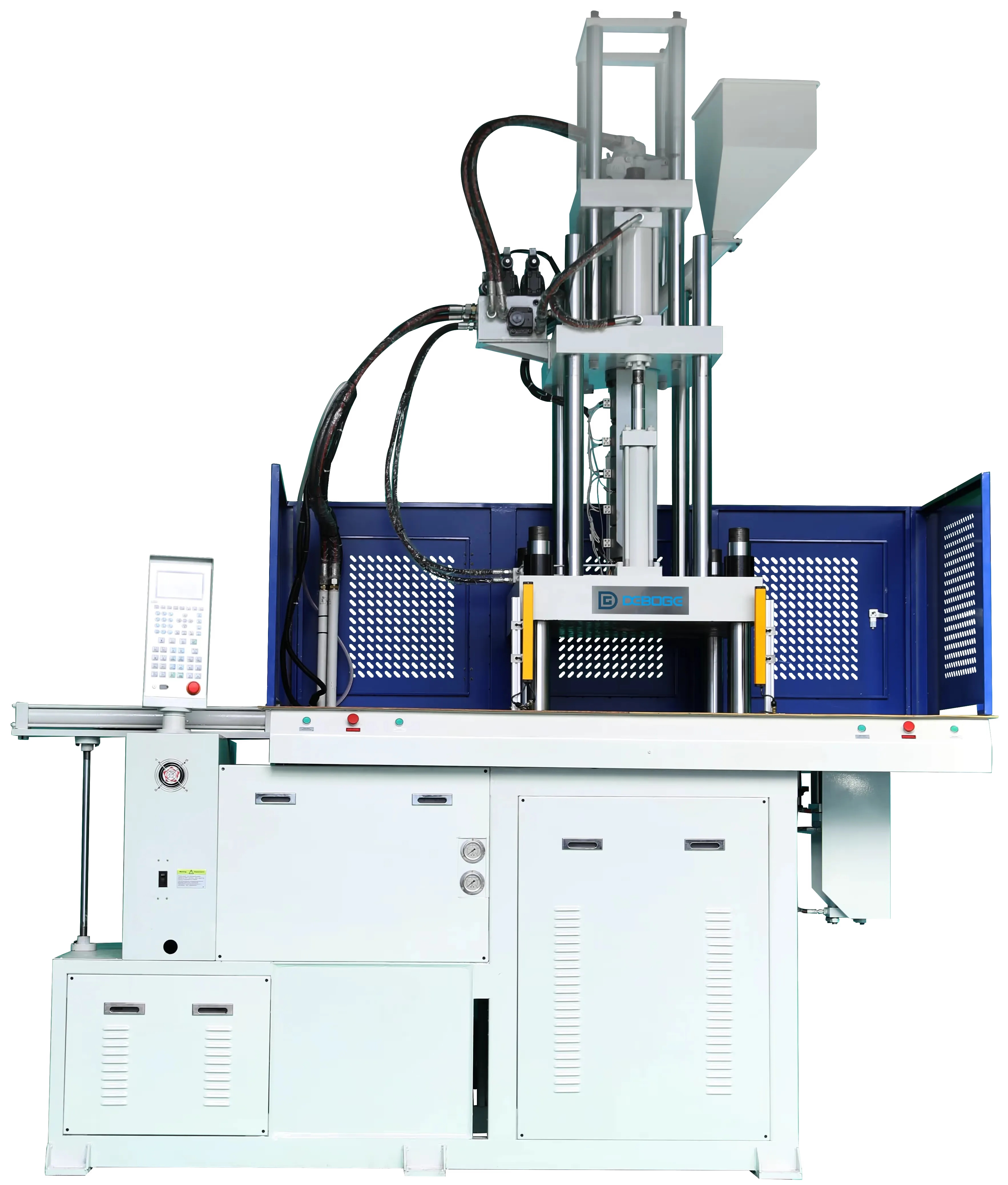
Single Slide Table
One platen. Slide out, load, slide in, mold. Repeat.
The simplest moving-table configuration. After each molding cycle, the lower platen slides out on linear rails to the loading position. The operator removes the finished part, places inserts, and the platen slides back under the clamping unit for the next cycle. One operator manages the full sequence.
- 1. Slide Out
- The mold is fully accessible - operator can reach all cavities without leaning into the machine.
- 2. Load
- Better ergonomics and clearer sight lines than reaching into the clamping area to load inserts.
- 3. Slide In
- Mechanical stops and alignment guides support consistent positioning cycle after cycle.
- 4. Clamp & Inject
- The slide mechanism stays locked during injection - clamp force is delivered through the frame, not the rails.
Why single slide
- - Lower equipment complexity: One slide mechanism and one platen create a simpler layout than double slide or rotary configurations.
- - Typical fit for batch production: When production runs are measured in hundreds or low thousands rather than continuous high volume, single slide balances loading access and equipment complexity.
- - Complex insert placement: Full mold access at the loading station - operators can carefully position multiple inserts per cavity without time pressure from the molding cycle.
- - DA Series exclusive: Available on DA Series from DA-150S to DA-2100S (9 models, 150-2,100 kN). DC and DK Series do not offer single slide - their slide table offerings are double slide only.
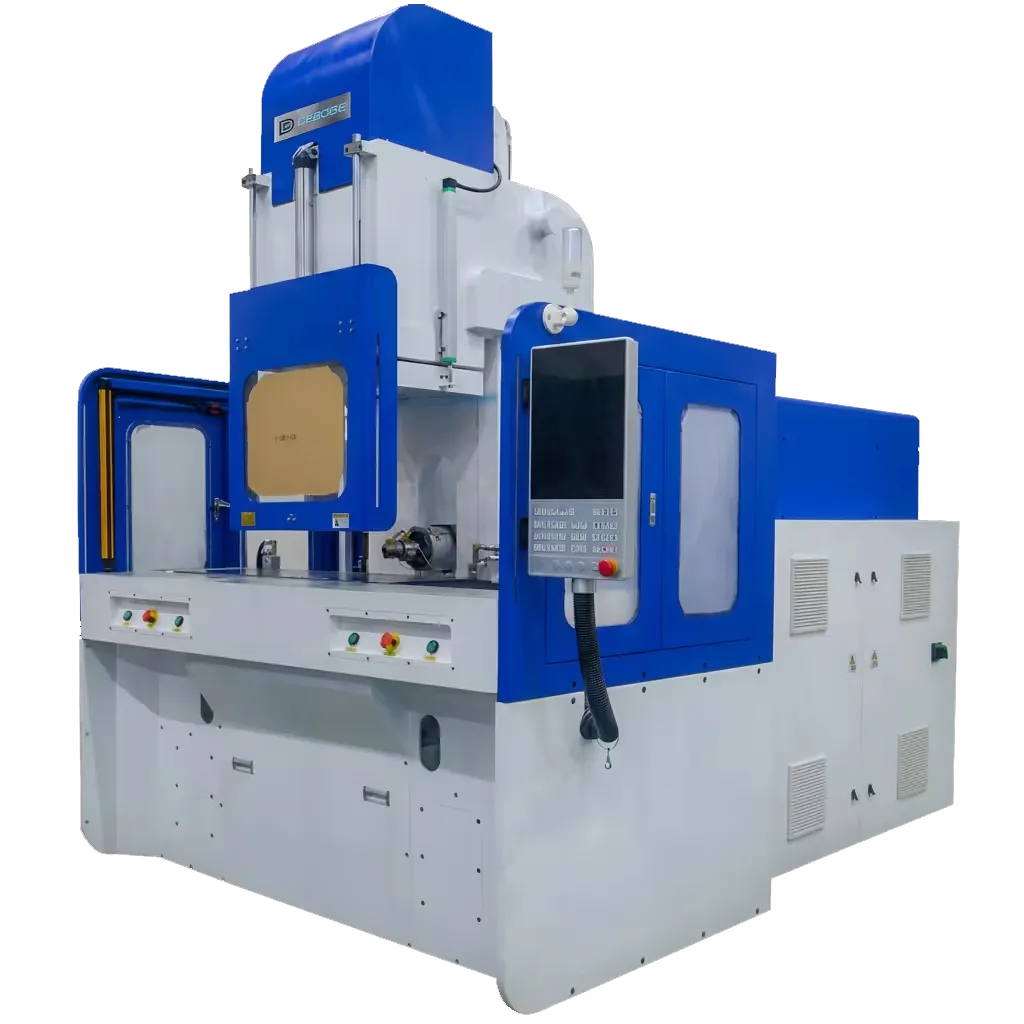
Double Slide Table
While one platen molds, the other is loaded - no idle time
Two lower platens alternate positions on a shared rail system. While Platen A is under clamp for injection, Platen B is at the loading station for part removal and insert placement. When injection completes, the platens swap - A moves out for unloading, B slides in for molding. Loading time overlaps with molding time.
Station A | Molding
- - Platen A under clamp
- - Material injected
- - Part molded & cooled
Station B | Loading
- - Finished part removed
- - New inserts placed
- - Ready for next cycle
Making the Choice
Single slide or double slide - how to decide
Both move the mold to the operator. The deciding factor is whether your insert loading time is long enough to benefit from overlapping it with the molding cycle.
Sequential cycle
Single Slide Table
- Platens
- 1 moving lower platen
- Workflow
- Load -> Mold -> Unload (sequential)
- Operator
- 1 operator manages full cycle
- Cost
- Lower equipment investment
- Availability
- DA Series only - DA-150S to DA-2100S (9 models)
Often reviewed for small-to-medium batch production, complex insert placement where loading time varies per part, and operations where one skilled operator handles the complete molding cycle.
Alternating cycle
Double Slide Table
- Platens
- 2 alternating lower platens
- Workflow
- Load -> Mold (parallel, alternating)
- Operator
- 1-2 operators can work simultaneously
- Cost
- Higher investment, faster payback at volume
- Availability
- DA (8 models), DC (4 models), DK (5 models) - 17 models across all series
Often reviewed for higher-output insert molding where loading time is a significant portion of the cycle, operations that benefit from two operators working in parallel, and applications where loading efficiency is a major constraint.
Compatible Series
Slide tables across the Deboge platform
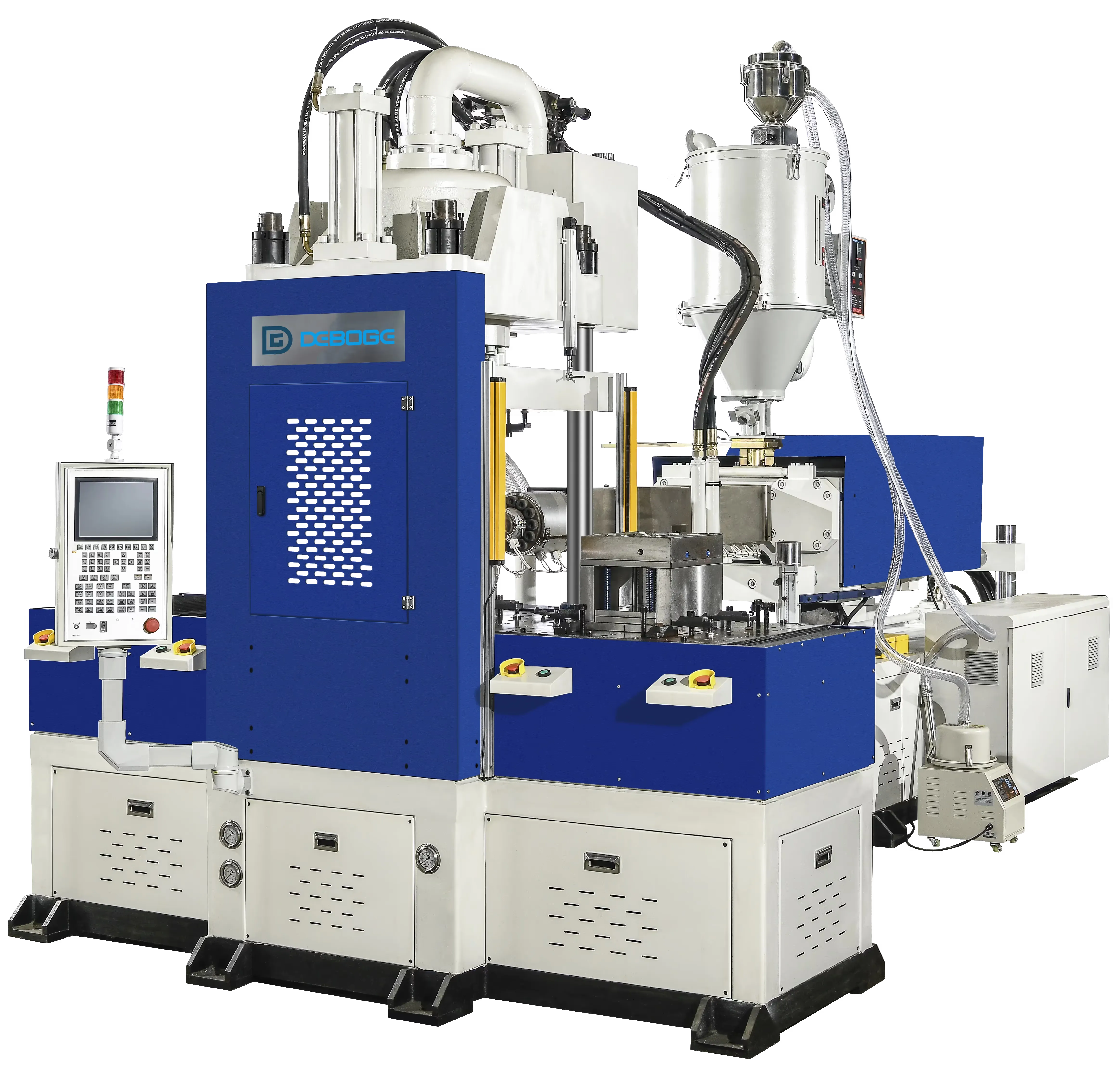
All three series offer slide table configurations, but model availability differs. DA Series is the only platform with single slide. Double slide is available across DA, DC, and DK.
DA Series
Standard Vertical Injection
DA offers both single slide (9 models, DA-150S - DA-2100S) and double slide (8 models, DA-150DS - DA-1600DS) with vertical clamping and vertical injection. The only series that provides single slide configuration.
View series detailsDC Series
Tie-bar-less Vertical Clamping
DC offers double slide (4 models, DC-450DS - DC-1200DS) with a tie-bar-less open structure. No tie-bars means unobstructed access to both slide stations.
View series detailsDK Series
Vertical Clamping | Horizontal Injection
DK offers double slide (5 models, DK-1200DS - DK-3000DS) with horizontal injection for larger shot sizes. The injection unit stays fixed while only the lower platens slide - keeping the injection axis stable.
View series detailsEach series page includes complete slide table specification tables - model numbers, clamp force, screw diameter, shot weight, and machine dimensions. Full 25-parameter data sheets are available on request.
Typical Applications
Applications that benefit from slide table access
Slide tables are the most widely applicable moving-table configuration. They are recommended when the operator needs clear access to place inserts, when insert geometry is complex, or when manual loading is the primary production method.
Choosing Your Configuration
Slide table fits between fixed platen and rotary - here's when to choose each
The three table configurations form a spectrum from simplest to most continuous. Slide table is the middle ground - more loading efficiency than fixed platen, less equipment complexity than rotary.
Simplest
Fixed Platen ->
Table stays still. Best when inserts are easy to place without moving the mold.
Middle ground
Slide Table
Table slides out to operator. Best when insert loading benefits from moving the mold - single for batch work, double for higher output.
You are here
Most continuous
Rotary Table ->
Table rotates stations. Often reviewed for high-volume production where loading and molding run in parallel.
Related Machine Information
Frequently Asked Questions About Slide Table Machines
What is the difference between single slide and double slide table?
Which series support slide table configurations?
When should I choose a slide table over a fixed platen?
How does slide table compare to rotary table?
How do I decide between single slide and double slide?
Does the slide mechanism affect clamping precision?
Not sure whether single or double slide fits your production?
Send your insert type, mold layout, operator workflow, and target output so the engineering team can review the slide table configuration path for your application.