
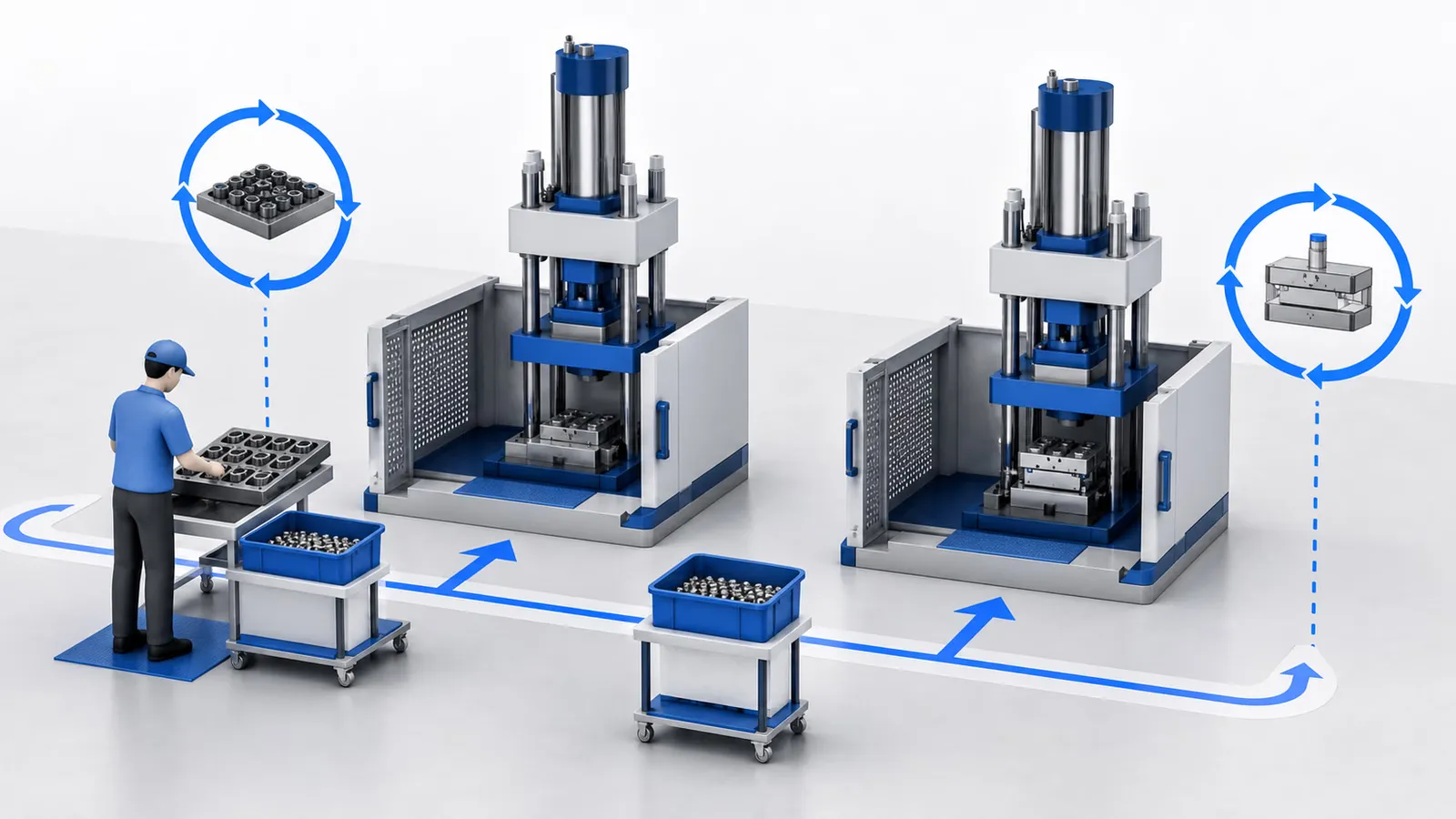
Long Insert Loading Time: Workflow Troubleshooting Guide
Review long insert loading time by checking mold access, fixture design, operator reach, insert orientation, table layout, and automation readiness.
2026-07-12 - 8 min diagnostic read - Category: Process Issues
Long insert loading time can reduce output even when the injection sequence is stable. The issue may come from insert orientation, fixture complexity, mold access, operator reach, preparation flow, table layout, inspection steps, or unrealistic automation expectations.
Quick Answer
Time the loading task before discussing machine speed. Record how long it takes to pick, orient, place, confirm, and clear the mold area. Then decide whether the bottleneck is access, fixture design, insert presentation, operator workflow, or table configuration.
What You May See
- The machine waits for insert loading before mold close.
- Loading time changes by operator, insert type, side, or station.
- Inserts are dropped, reversed, tilted, or not fully seated.
- Operators need extra reaching, turning, checking, or manual positioning.
- Cycle time does not improve even after machine sequence adjustments.
Likely Cause Areas
- Insert orientation may be difficult to recognize or repeat quickly.
- Fixtures may require too many small alignment steps.
- Mold access may be restricted by platen layout, mold height, or surrounding equipment.
- Insert supply, tray layout, or pre-positioning may not support the cycle target.
- The chosen table configuration may not separate loading work from machine time effectively.
- Automation may be discussed before the manual process is stable enough to automate.
Safe Checks Before Adjustment
Stop automatic operation if movement, alarm, guarding, or operator safety is uncertain. Do not place hands in the mold, table, injection, or guarded area while movement is possible. Use photos, controller screenshots, cycle logs, and safe observation before changing several settings.
Diagnosis Path
- Break loading into pick, orient, place, confirm, and clear steps.
- Measure each step for several cycles and operators.
- Identify whether the slowest step is insert supply, orientation, fixture seating, or access.
- Check whether loading errors create short shots, insert shift, flash, or exposed inserts.
- Review table type and whether loading happens during or outside the automatic sequence.
- Photograph fixture layout and operator reach under safe stopped conditions.
- Simplify insert presentation or fixture confirmation before assuming automation is required.
- Use the recorded workflow to discuss manual, semi-automatic, or automatic loading options.
Evidence to Collect
| Check | Why It Matters | Evidence to Collect |
|---|---|---|
| Step timing | Shows the real bottleneck in the loading task | Timing log for pick, orient, place, confirm, clear |
| Fixture layout | Fixture design controls speed and repeatability | Photos of fixture and insert seating position |
| Operator access | Poor access creates slow and variable loading | Safe workflow video and reach notes |
| Error pattern | Loading errors connect workflow to part defects | Defect photos linked to loading observations |
| Table workflow | Table type determines whether loading time overlaps machine time | Machine model, table type, and cycle layout |
What Not to Change Too Quickly
- Do not assume automation is the first answer to long loading time.
- Do not speed up loading by removing confirmation steps that prevent insert shift.
- Do not ask operators to reach into unsafe or awkward positions.
- Do not evaluate machine output without measuring insert preparation flow.
When to Contact Deboge
Contact Deboge when loading time controls output or creates insert defects. Send insert and fixture photos, table type, loading step timing, target output, product requirement, and a safe workflow video.
Related Reading
Related Reading
Related Questions
Is long loading time always solved by automation?
No. Many loading problems should first be reviewed for mold access, fixture support, insert orientation, preparation flow, and table layout before automation is discussed.
What loading steps should be timed?
Time picking, orientation, placement, seating confirmation, and clearing the mold area. This shows whether the issue is access, fixture, insert supply, or workflow.
Can loading time cause part defects?
Yes. Long or inconsistent loading can lead to insert shift, exposed inserts, short shot, temperature variation, or unstable cycle time.
When should table configuration be reviewed?
Review table configuration when loading time prevents the machine from cycling efficiently or when loading work cannot be separated from automatic machine time.
Need help with this issue?
Send the machine model, material, mold or insert details, defect photos, alarm screenshots, and recent changes. Deboge can review the information and suggest the next diagnostic step.