
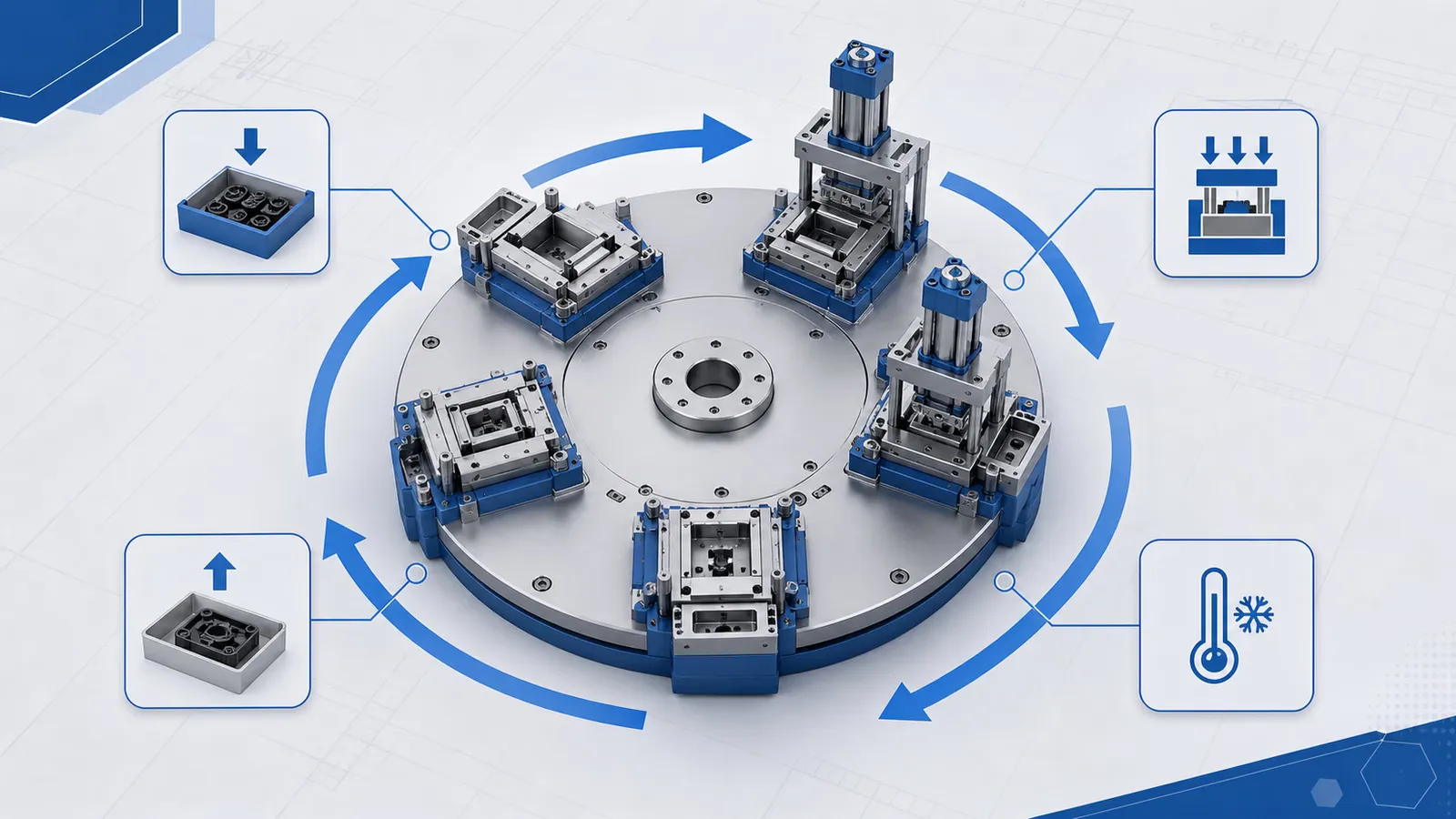
Fixed Platen vs Slide Table vs Rotary Table Guide
Compare fixed platen, slide table, and rotary table vertical molding machines by loading workflow, mold access, part removal, cycle rhythm, and automation planning.
2026-07-11 | 10 min read | Category: Choose by Machine Structure
Table configuration is one of the most important decisions in vertical molding machine selection. Fixed platen, slide table, and rotary table layouts create different working conditions for loading, mold access, part removal, and production rhythm.
This guide helps you compare table options from the workflow instead of choosing by popularity. A table should be selected because it supports the part, mold, operator or robot path, and cycle expectations.
Quick Answer
Choose fixed platen when loading and removal are simple in the main mold area. Review slide table when the lower mold area should move outward for safer or clearer access. Review rotary table when station separation can improve loading, molding, cooling, unloading, or automation rhythm.
When This Guide Is Most Useful
Use this guide when the machine structure is not the only question and the main uncertainty is how the product will be loaded, molded, removed, and repeated cycle after cycle.
Selection Path
Map the loading task
Identify what the operator or robot must place in the mold, how precise the placement must be, whether fixtures are needed, and how much time loading requires.
Review mold access and safety distance
The table should provide practical access without forcing awkward movement around the mold. Slide and rotary layouts can move loading or unloading work away from the main clamp area when the project needs it.
Check part removal and cooling or curing needs
Some parts are removed immediately. Others need careful release, fixture support, cooling time, curing time, or inspection. These requirements can change whether a single station or multi-station workflow is more suitable.
Consider future automation
A table that works for manual loading may not always work for future robots, part pickers, or fixture carriers. If automation may be added later, access and station position should be discussed early.
Decision Points to Review
| Review point | Why it matters | What to prepare |
|---|---|---|
| Loading position | It determines whether work happens inside the clamp area or at an outside station. | Photos or notes showing operator or robot approach. |
| Part removal | Unloading can be the limiting step even when loading is simple. | Removal method, part flexibility, and collection plan. |
| Cycle rhythm | Station separation may reduce waiting time or improve organization. | Estimated loading time, molding time, and cooling or curing needs. |
| Automation path | Robots and fixtures need predictable access and clearance. | Robot approach, fixture size, and safety concept if available. |
How to Compare Common Options
| Option | When it may fit | What to verify |
|---|---|---|
| Fixed platen | Simple manual loading, low access complexity, and straightforward removal. | Whether all work can be done comfortably in the fixed mold area. |
| Slide table | Loading or checking benefits from moving the lower mold area outward. | Slide direction, stroke, fixture height, and operator reach. |
| Rotary table | Repeated stations can support loading, molding, cooling, unloading, or automation rhythm. | Station sequence, indexing clearance, and part handoff. |
Information to Prepare Before Asking for a Recommendation
| Information | Why Deboge needs it |
|---|---|
| Loading sequence | It shows whether one station is enough or separation is useful. |
| Mold size and fixture layout | Table choice depends on physical clearance and movement. |
| Expected cycle and loading time | Table value depends on the full workflow, not just injection time. |
| Automation expectations | Future robots may require a different station arrangement. |
Common Mistakes to Avoid
- Choosing rotary table only because it looks more automated.
- Choosing fixed platen before checking loading reach and removal space.
- Ignoring cooling or curing time when comparing table options.
- Reviewing table choice without the mold and fixture concept.
How This Guide Connects to Other Resources
Use this guide after the basic machine selection path is understood. For application-specific loading questions, continue with insert molding, metal insert molding, cable connector overmolding, or automation-ready guides.
Related Reading
FAQ
Is rotary table always better than fixed platen?
No. Rotary table is useful when station separation improves the workflow. If loading and removal are simple, fixed platen may be enough.
When should a slide table be reviewed?
Review slide table when the lower mold area should move outward for loading, insert placement, inspection, or part removal.
What information is needed to compare table configurations?
Prepare the loading sequence, mold concept, fixture size, removal method, cycle expectations, and any automation plan.
Can table configuration affect automation planning?
Yes. Station position, access direction, table movement, and safety planning all affect future robot or fixture integration.
Related Reading
Ready to confirm a machine selection?
Send your product details, mold specs, and production requirements. Deboge engineering will review and recommend a specific configuration.