
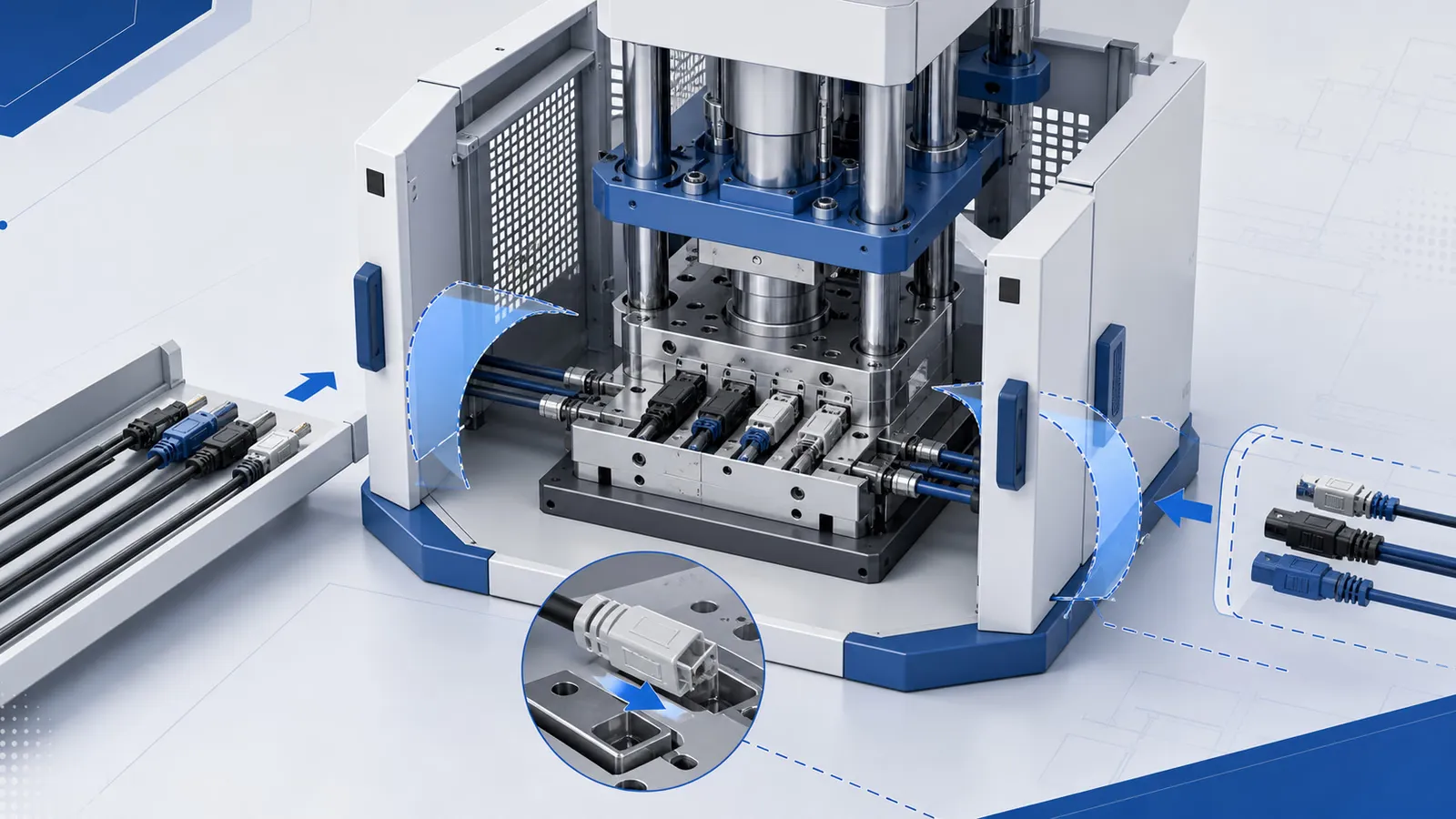
Why Open Mold Access Matters in Cable Connector Overmolding
Cable connector overmolding article explaining why wire routing, insert placement, mold access, and clamping structure should be discussed together.
2026-07-08 | 7 min read | Category: Application Notes
Cable connector overmolding is not only a plastic molding question. It is also a handling and access question. Wires, cables, terminals, strain relief features, and connector inserts must be positioned before mold closing. If the mold area is hard to reach, the production workflow becomes slower and less predictable.
The primary application page is cable connector overmolding. This Blog article explains the machine selection angle.
The Product Extends Beyond the Mold
Many molded products stay entirely inside the mold area. Cable and connector projects are different because part of the product often extends outside the cavity. Wires or cables may need to be routed, held, or supported before the mold closes. The operator may need to check terminal position, cable direction, and insert seating before injection.
This means the machine must support more than clamp force and injection. It must support the human or automated work around the mold.
Tie-bars Can Become Workflow Obstacles
Conventional vertical clamping structures use tie-bars around the clamping area. For many insert molding projects, this is acceptable. In cable connector overmolding, tie-bars can interfere with how cables are placed or routed. The issue is not only physical collision. It can also be slower reach paths, awkward hand movement, and limited visibility.
This is where tie-bar-less vertical clamping machines may enter the discussion. DC Series means tie-bar-less vertical clamping. The benefit is open access around the mold area. Injection direction depends on configuration and should be reviewed according to the product and mold concept.
Table Configuration Also Matters
Open clamping access is only one part of the workflow. The table configuration decides where loading happens. A slide table machine can move the lower mold half out of the clamping zone, giving the operator a clearer loading position. A rotary table may be discussed when repeated loading and unloading need a station-based rhythm.
The correct choice depends on the cable length, insert count, fixture method, operator access, and production target. No table type should be chosen from the product name alone.
Questions to Ask Before Choosing a Structure
For cable connector overmolding, prepare answers to these questions:
- Do cables extend out of the mold during closing?
- Does the operator need to route wires around fixtures?
- Are metal terminals placed individually or preassembled?
- Is the cable supported by a fixture before injection?
- Is front access enough, or is side access also needed?
- Will manual loading remain, or is automation planned later?
These questions help Deboge discuss whether DA, DC, DK, slide table, rotary table, or a custom layout should be evaluated.
Material Discussion Should Be Separate
Cable overmolding may involve soft or flexible materials, engineering plastics, or other material families depending on the product. The material choice affects processing and mold discussion, but it should not be simplified into a general compatibility claim. Use soft and flexible materials as a reference starting point, then confirm project details with material and mold information.
A Better Inquiry Package
For cable connector projects, send product photos, connector drawings, cable length information, terminal details, material family, and any existing mold or fixture concept. A short video of the loading method is especially useful if the process already exists.
If the project is still early, send what is available through Contact Deboge. The goal is to discuss mold access, clamping structure, injection direction, table configuration, and loading workflow together rather than treating them as separate decisions.
Related Reading
Have a question about this topic?
Contact Deboge engineering for technical questions specific to your application and production requirements.